
Wire Rope
Rigging supplies tend to fail when paired with the wrong rope. The label on the old cable does not tell the whole story. A customer may ask for 7×7, 7×19, or GAC wire because that label appeared on a prior order, an old invoice, or the cable being replaced. We still need to know what the cable is doing in the application. A wire rope holding a static position has a different job than one moving through a winch, adjusting in place, or being used by a scaffolding company.
That is the difference between ordering by name and choosing by application. A 7×7 wire rope is preferred when rigidity helps the cable hold position. A 7×19 wire rope is required when flexibility, adjustment, or dynamic positioning matters. Neither construction is automatically better, because the right choice comes from matching the wire rope to the actual job.
The Main Difference Is How the Wire Rope Moves
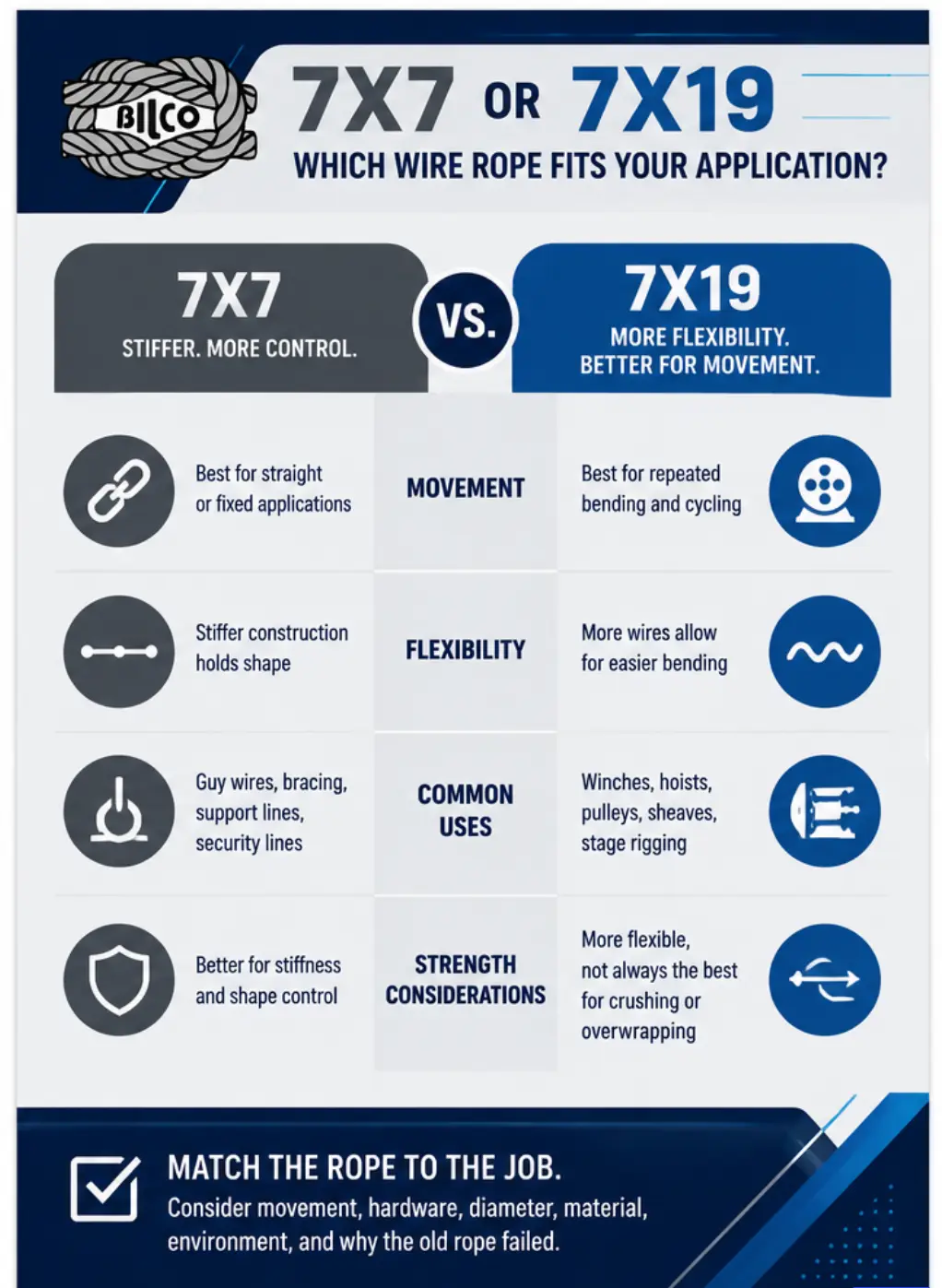
A 7×7 wire rope has 7 strands with 7 wires in each strand. A 7×19 wire rope has 7 strands with 19 wires in each strand. That difference matters because more smaller wires usually give the rope more flexibility, while fewer larger wires usually give the rope a firmer feel.
That construction difference only becomes useful when it connects back to the application. A rope in a static position or serving as a guywire needs different behavior than one used for adjustment, dynamic positioning, or frequent movement. The choice is less about memorizing strand counts and more about understanding what the rope must do after installation.
Buyers often ask whether 7×7 or 7×19 is stronger, better, or more common. Those questions do not go far enough. The better question is whether the application needs rigidity, flexibility, or controlled movement.
How Movement Changes the Selection
Movement changes the selection because the rope has to handle more than tension. A fixed wire rope and a moving wire rope face different service demands. The more the rope bends, repositions, or works through hardware, the more construction matters.
- Static or fixed applications:A more rigid construction often suits when the cable holds its position and does not require frequent adjustment. This is where 7×7 often deserves consideration.
- Adjustable or dynamic applications:A more flexible construction usually fits better when the rope needs movement, repositioning, or operation through equipment. This is where 7×19 often becomes the better starting point.
- Replacement applications:The old rope should not be matched by label alone. The application, wear pattern, hardware, diameter, fittings, and environment should guide the replacement.
When 7×7 Wire Rope Makes Sense
A 7×7 wire rope often fits applications where the cable needs a firmer, more controlled feel. We often see 7×7 used when the rope needs to hold position rather than move frequently. The more rigid construction makes sense when the job depends on control, support, or a fixed path.
Common 7×7 applications include:
- Static lifts:The cable holds a set position rather than requiring frequent adjustment.
- Permanent fixtures:The rope supports a fixed use where rigidity helps maintain control.
- Bracing lines: The cable helps support or stabilize the application.
- Guywire:The rope helps hold a fixed structure in position.
The important point is not that every static application automatically takes 7×7. The point is that 7×7 belongs in the conversation when the rope does not need frequent adjustment or dynamic movement. Diameter, material, coating, fittings, and hardware contact still affect the final choice, but rigidity is the reason 7×7 often fits these uses.
Where 7×7 Usually Creates Problems
A 7×7 wire rope is a poor fit when the application requires frequent adjustment, dynamic positioning, or a more flexible cable. A stiffer rope in a moving path may handle poorly or wear faster in areas where the cable bends through hardware. That concern grows when the rope passes through hardware that forces sharper movement.
The issue is not quality. The issue is fit. When a buyer chooses 7×7 because the size looks right, but the application needs flexibility, the selection starts from the wrong detail.
When 7×19 Wire Rope Makes Sense
A 7×19 wire rope is often used in applications where the cable needs greater movement, adjustment, or flexibility. The added wires help the rope bend and reposition more easily than 7×7. We often see 7×19 used when the application asks the cable to move rather than hold a static position.
Common 7×19 applications include:
- Scaffolding work:The cable may need positioning, adjustment, or flexible handling.
- Winch use:The rope moves through equipment instead of staying fixed.
- Fencing applications:Flexibility helps with handling, placement, and installation.
Flexibility matters because the rope is not only holding tension. The rope is moving through a system, changing position, or working through a use case where a rigid cable would be harder to handle. In those situations, 7×19 becomes the logical starting point because the construction better matches the movement required by the job.
Why 7×19 Is Not Always the Better Choice
A 7×19 wire rope is more flexible than 7×7, but flexibility does not solve every selection problem. Some applications benefit from a more rigid cable because the rope needs to hold a position, serve as bracing, or work as guywire. In those cases, choosing 7×19 only because it is more flexible moves the buyer away from what the application needs.
That is why “7×19 is more flexible” should not turn into “7×19 is always better.” The best construction depends on what the rope has to do in service. Dynamic positioning may drive one decision, while a static fixture may drive another.
Why Matching the Label Is Not Enough
Many customers start with the label they already have. They ask for 7×7, 7×19, GAC wire, or aircraft cable because that is what appeared on a prior order, an old invoice, or the cable being replaced. That request is useful, but it does not answer the main selection question. The construction should be selected after the application is clear.
GAC wire usually refers to galvanized aircraft cable in commercial wire rope conversations. Some buyers also use aircraft cable as a general term for small-diameter wire rope, especially around 7×7 and 7×19 constructions. That wording should not be treated as a complete specification by itself.
The application still has to explain whether the cable needs rigidity, flexibility, adjustment, or dynamic positioning. It should also clarify any corrosion, fitting, or certification requirements before the order is finalized. A construction label helps identify the request, but it does not replace the details that determine whether the rope will fit the application.
A replacement order should also account for the failure pattern. Wear at a pulley points to a different issue than corrosion along the rope. Fraying near a fitting points to a different concern than flattening on a drum. If the old rope failed early, matching the construction without asking why may repeat the same problem.
Common Ways a Poor Fit Shows Up
The first warning sign is often not a complete break. The rope usually shows a change in wear, movement, or fit before total failure. Those clues help identify whether the construction, hardware, or environment needs closer review.
- Wear near a pulley or sheave:The rope may be bending too tightly or moving through a path that needs review.
- Flattening on a drum:The rope may be seeing crushing, overwrap, or contact conditions beyond a simple construction issue.
- Fraying near a fitting:The assembly detail or attachment point may be creating concentrated stress.
- Early corrosion:The material or coating may not match the environment.
- Repeat failure in the same location:The replacement may be copying the old problem instead of correcting the application issue.
Each clue points back to the same selection principle. The construction label helps, but the application explains what the rope is really facing. A better replacement starts with the use case before the order details get finalized.
Do Not Choose 7×7 or 7×19 by Strength Alone
Strength matters, but strength should not define the whole comparison between 7×7 and 7×19 wire rope. Breaking strength depends on diameter, material, grade, construction, fittings, and how the rope is used. A stronger-looking option on paper may still perform poorly if it does not match the application.
The better question is not “Which construction is stronger?” The better question is “Which construction fits what the rope needs to do?” A static fixture, bracing line, or guywire points toward different rope behavior than a winch, fencing application, or adjustable setup.
This matters most when the rope is part of lifting, control, safety, or another load-critical use. The application should drive the review before the construction is selected. When the use is critical, the old rope failed early, the hardware path is unclear, or the application is changing, the order should include more than a construction name.
Choosing Between 7×7 and 7×19 Wire Rope
Choosing between 7×7 and 7×19 wire rope starts with the application, not the construction label. A 7×7 wire rope is preferred for static lifts, permanent fixtures, bracing lines, and guywire where rigidity helps the cable hold a controlled position. A 7×19 wire rope is required when the job needs adjustment, dynamic positioning, winch use, fencing use, scaffolding use, or more flexibility. The construction should also be reviewed against diameter, material, coating, hardware, end fittings, environment, and the condition of the rope being replaced. Many customers start by asking for GAC wire or aircraft cable, but the better order starts by explaining what the cable needs to do. The right choice is the wire rope construction matched to the actual application.