
A wire rope request can begin with information that has followed the equipment for years: an old purchase order, a familiar designation such as 6×19, or terminology everyone inside the operation understands. That information can provide a useful starting point without identifying the exact rope the buyer needs today. A class designation can describe a broader family of constructions, while other specifications remain unstated. Industrial buyers need to separate the class from the specific construction and identify the other known product details rather than assume that familiar shorthand tells the whole story.
We at Bilco regularly work with requests where some specifications are precise, and others need clarification. The missing information varies by customer, so no single detail is overlooked by every buyer. The goal is to establish what the customer already knows, clarify the terminology, and identify what product information still needs to be resolved. We can then supply or source products against an established specification without taking over the application-specific decisions that belong with the appropriate manufacturer or qualified party.
A 6×19 Class Does Not Always Mean an Exact 6×19 Construction
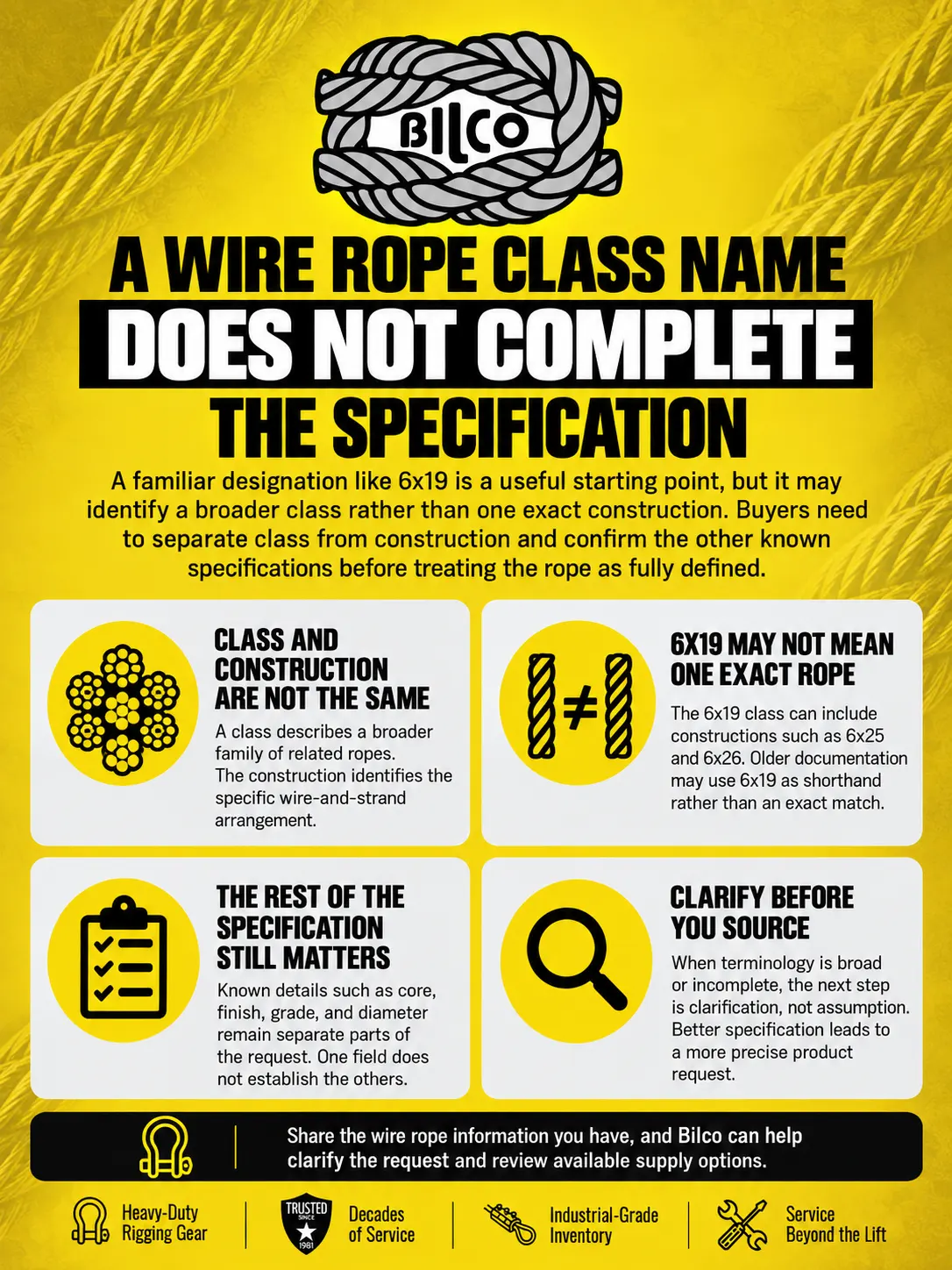
Wire rope class and wire rope construction describe related but different things. A class groups related rope constructions, while the construction identifies the particular arrangement of wires and strands within that broader family. That distinction matters because a class name can appear precise even when it leaves more than one construction possible. Buyers working from older documentation should not automatically assume that a familiar class designation identifies one exact rope.
The 6×19 class provides a useful example. Constructions such as 6×25 and 6×26 fall within the broader 6×19 family, even though neither contains exactly 19 wires per strand. Some customers specifically ask us for a “true 6×19,” while others use 6×19 because that designation appears on older documentation. When a true 6×19 construction is required, we can pursue that option with the mill, but the distinction needs to be clear first.
This is where the terminology can create unnecessary confusion if everyone treats the class name as the complete construction. A buyer may intend to replace an existing rope exactly, while another buyer may simply be using the broad classification found on a previous order. Those are not necessarily the same request. Clarifying that difference gives us a much better basis for identifying what is actually being requested.
| Specification | What It Identifies | What It Does Not Establish by Itself |
| Wire rope class | A broader family of related constructions | The exact construction |
| Specific construction | The particular wire-and-strand arrangement within that class | Core, finish, grade, diameter, or other remaining specifications |
| “6×19” on older documentation | A reference that may describe the broader class or a specific construction | Which meaning the buyer intends without additional context |
A classification narrows the product family, but it does not automatically complete the specification. When exact construction matters, buyers need to distinguish that construction from the broader class rather than treating the two terms as interchangeable.
The Class Name Does Not Supply the Rest of the Rope Specification
Even when the buyer knows the class and construction, those details do not automatically establish the rest of the rope specification. Wire rope includes several separate product characteristics, and each one identifies something different about the rope. Knowing one field does not give us license to infer the others. The more of those details the buyer already has, the more precisely we can identify the requested product.
The known specification may include:
- Specific construction: The exact construction within the broader class.
- Core: The core designation already established for the rope.
- Finish: The specified finish or coating.
- Grade: The grade identified in the product specification or documentation.
- Diameter: The nominal rope diameter.
- Class: The broader classification when that is the level of information available.
These details work together to describe the product, but they do not all come automatically with the class name. A request for “6×19” gives us useful information, but a request that also identifies the specific construction, core, finish, grade, and diameter defines the product much more precisely. That precision helps us determine what we have available or can source. It also reduces the risk of treating an unstated specification as though the customer had already established it.
Broad or Incomplete Terminology Calls for Clarification, Not Assumptions
Customers do not always use formal manufacturer terminology, and that does not make the request invalid. Industry shorthand, internal company language, and older purchasing terms often carry over from one order to the next. We at Bilco sometimes hear the term “choker,” for example, when a customer is referring more broadly to a wire rope sling. The useful next step is to clarify exactly what product the customer means rather than focus on whether the terminology was technically precise from the start.
The same principle applies when the request does not include every specification. One customer may know the construction but not have another product detail readily available, while another may begin with an older document and only part of the original specification. The amount of information available depends on the customer and the situation. We do not treat one missing field as the universal problem.
When a request leaves an important detail unclear, we work to clarify the information or provide enough product detail for the customer to describe the available option more accurately. That approach keeps the conversation focused on what the customer actually wants instead of filling gaps with assumptions. We can explain terminology, distinguish specifications, and identify supply options without deciding which construction, core, finish, or grade the application requires. The final application-specific determination remains with the customer and the appropriate manufacturer or qualified party.
Precise Classification Makes the Product Request More Precise
A buyer working from “6×19” on an old order may already have valuable information, but that designation does not always identify one exact construction. The 6×19 class can include constructions such as 6×25 and 6×26, so the distinction between class and construction matters when an exact product is required. Core, finish, grade, diameter, and other known product details remain separate parts of the specification, not assumptions tied to the class name. When information is incomplete, we at Bilco clarify the request instead of assigning blame or filling in technical details that the customer has not established. We then use the established specifications to identify available products and sourcing options.
Contact Bilco with the wire rope information you have, and we can help clarify the request and review available supply options.