A shackle might fit the connection point and still be the wrong part for the lift. Two shackles with similar dimensions might carry different Working Load Limits, use different steel grades, or require different pin-securing systems. A replacement pin might pass through the shackle eyes without being part of the rated assembly. Visual fit alone does not confirm capacity, compatibility, or traceability.
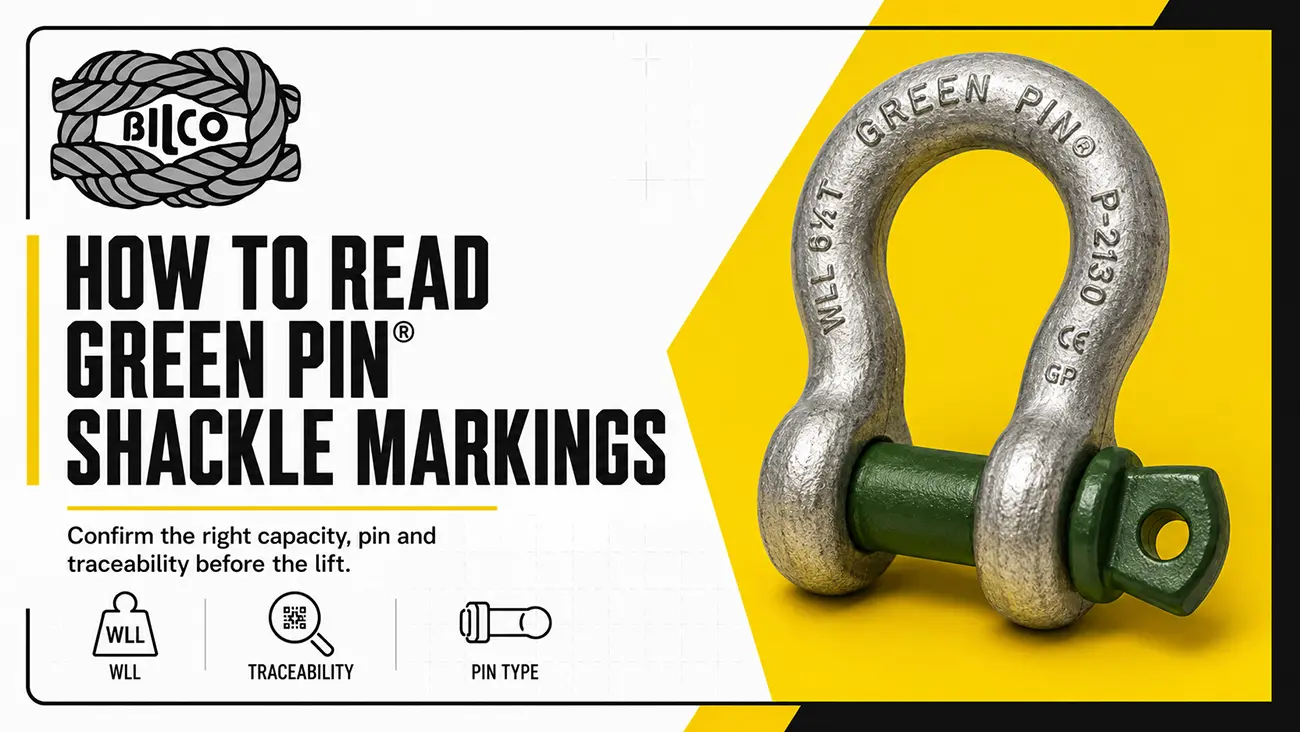
Green Pin® shackle markings provide the information needed to verify the hardware before use. The stamped WLL, manufacturer symbol, steel grade, and traceability code establish the identity of the physical shackle. Product codes found in specifications, quotes, and order records identify the body style and pin configuration. Reading both sets of information helps riggers, inspectors, and purchasing teams confirm that the hardware in the field matches the lift plan and supporting records.
Why Shackle Identification Requires More Than Checking the WLL
The Working Load Limit is the first marking most users look for, but it does not fully characterize the shackle. A marking such as “WLL 25 T” states the maximum rated load under the conditions established for that product. It does not show whether the connection introduces side loading, whether the sling angle increases leg tension, or whether temperature requires a reduction. The lowest-rated component in the complete lifting arrangement still limits the assembly.
Minimum Breaking Load should never be confused with Working Load Limit. Several standard grade 6 Green Pin® shackles have a Minimum Breaking Load equal to six times their WLL, while many grade 8 products use a five-to-one relationship. That safety factor supports the product’s design and testing. It does not authorize a user to exceed the marked WLL.
Several conditions must be considered before accepting the marked WLL as the usable capacity:
- Confirm the anticipated load, including any effects from sling angles or the hoisting arrangement.
- Keep the load perpendicular to the pin and within the plane of the shackle bow whenever the product requires in-line loading.
- Check the instructions for the exact model before applying a side load. Side-load reduction guidance does not apply equally across every Green Pin® product family.
- Account for shock loading, dynamic loading, extreme temperatures, and hazardous lifting conditions.
- Compare the shackle WLL with the ratings of the sling, hook, pad eye, master link, and every other connected component.
A shackle’s physical dimensions also matter. The attached fitting needs to bear correctly on the pin or bow without forcing the shackle eyes together or creating an eccentric load. Green Pin® guidance calls for keeping the load on the shackle centerline and using loose spacers when needed. Its Shackle Pocket Pilot identifies a pad-eye width between 60% and 90% of the shackle’s internal width. These checks connect the marked capacity to the geometry of the actual lift.
How the Physical Markings Establish Identity and Traceability
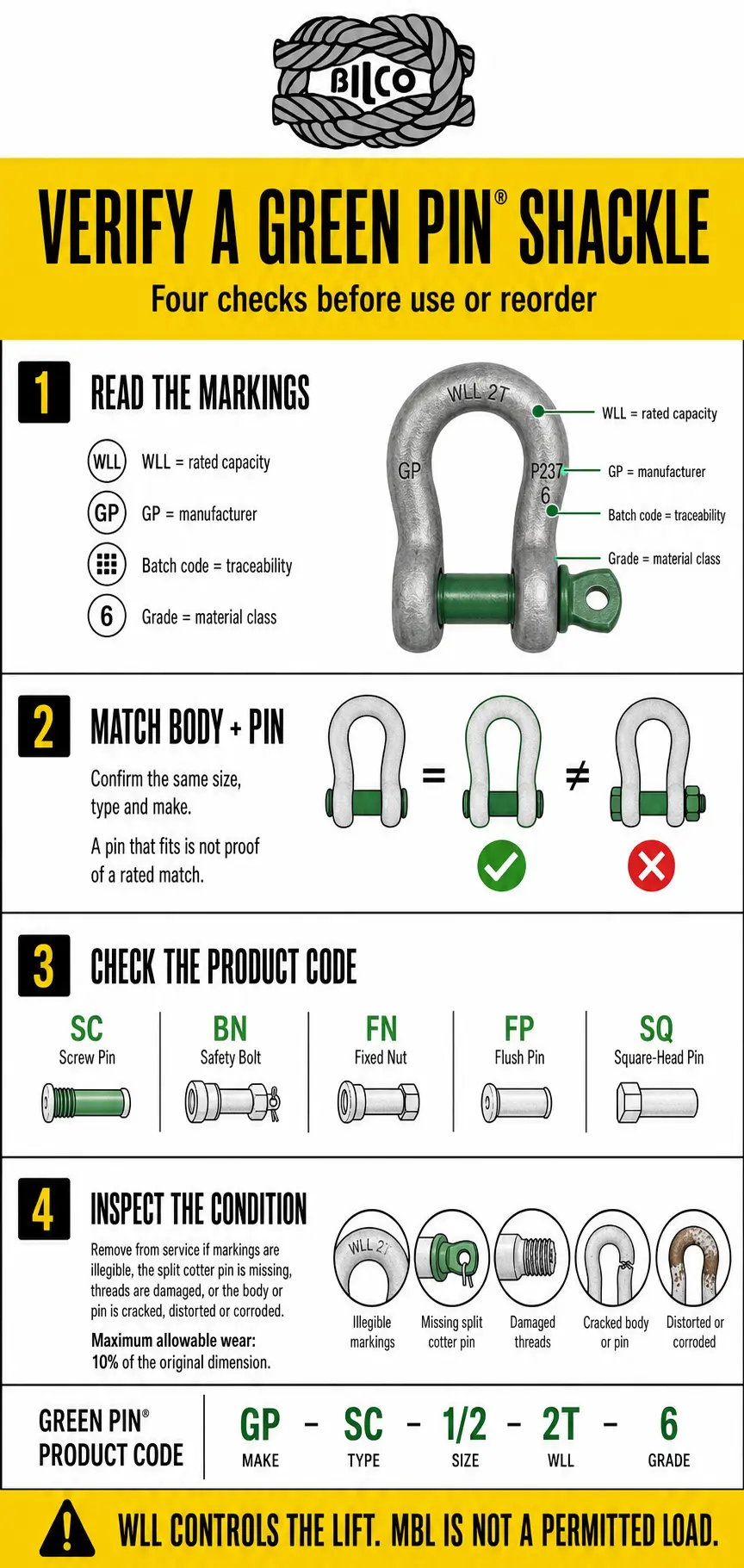
Green Pin® lists five general markings for load-rated lifting shackles. Each marking answers a different verification question. No single mark replaces the others, and all required markings must remain legible.
| Marking | Example | What it helps verify |
| Working Load Limit | WLL 25 T | Rated lifting capacity |
| Manufacturer | GP | Green Pin® manufacture |
| Traceability code | HA | Manufacturing batch |
| Steel grade | 4, 6 or 8 | Material classification |
| Conformity code | CE | European conformity |
The GP mark identifies the manufacturer, while the traceability code connects the shackle to a production batch. A code such as “HA” is not meant to function as a date or material formula for the user to decode. It creates a link between the physical component and its manufacturing or certification records. That connection becomes important when an inspector, purchaser, or project manager needs documentation for a specific shackle.
The steel-grade marking describes the material classification, but it does not specify capacity on its own. Standard Green Pin® bow and dee shackles commonly use quenched-and-tempered grade 6 high-tensile steel. Super®, Polar®, Heavy Duty, Sling, Power Sling®, BigMouth®, Web Sling, and ROV models commonly use grade 8 alloy steel. Users must still rely on the marked WLL and the specifications for the exact model and size.
Green Pin® also permits controlled addition of internal identification marks. Its current guidance calls for low-stress stamps, such as dot-peen or rounded-profile stamps. Additional marks should not be placed on the shackle crown, and pin markings belong only on the pin head. These restrictions help a company add an asset or inspection number without placing an uncontrolled stress concentration in a critical part of the shackle.
How Product Codes Identify the Pin and Shackle Configuration
The letters used in Green Pin® product names serve a different purpose from the markings stamped into the steel. These suffixes help buyers and rigging teams distinguish pin systems and special configurations in catalogs, specifications, quotes, and purchase records. They also reduce the chance of ordering a product that has the correct capacity but the wrong securing method.
The most relevant shackle suffixes identify these configurations:
- SC means Screw Collar or Screw Pin. Green Pin® documentation describes screw-pin shackles as intended primarily for nonpermanent applications where the load will not move across the pin and risk unscrewing.
- BN means Bolt and Nut or Safety Bolt. This configuration uses a safety bolt, nut, and split cotter pin for long-term use or applications where pin rotation presents a concern.
- FN means Fixed Nut. Green Pin® lists permanent connections, dynamic loading, and extreme vibration among the documented uses for its fixed-nut system. Green Pin® uses a securing bolt and Nord-Lock® washers to help hold the nut in position.
- FP means Flush Pin. The square sunken-hole design reduces the likelihood of the pin head catching on nets or lines. A matching key is required for removal.
- SQ means Square-Headed Screw Pin. Green Pin® uses this configuration on specialized fishing shackles where the operating environment influences the pin design.
These codes do not eliminate the need to check the complete product specification. Two BN shackles might have different WLL ranges, materials, temperature limits, dimensions, and certifications. The product family, model number, size, and suffix must match the application and purchase record. Current product information should take priority over assumptions based on one familiar code.
What to Verify Before Using or Reordering a Green Pin® Shackle
The shackle body and pin form one rated assembly. Green Pin® requires both pieces to be identifiable as the same size, type, and make. A pin taken from another shackle should not be installed because it appears to fit. Any replacement must match the original brand, type, make, and size to preserve the assembly’s stated WLL.
Identification must be combined with a physical inspection. Green Pin® inspection guidance sets a maximum allowable wear limit of 10% of the original body or pin dimension. It also calls for removal when markings become illegible, threads are damaged, the body or pin is distorted, or the component shows nicks, gouges, cracks, or corrosion. A safety-bolt shackle must not be used without its split cotter pin.
A practical verification should answer these questions before the shackle returns to service:
- Has the purchaser verified the marked WLL against the calculated requirement for the complete configuration?
- Do the manufacturer, grade, size, and shackle type match the specification?
- Are the body and pin part of the same rated assembly?
- Does the traceability code correspond with the available inspection and certification records?
- Does the product suffix identify the required screw pin, safety bolt, fixed nut, or specialty pin?
- Are all markings legible, and does the shackle pass the dimensional and condition inspection?
Project-specific certifications require the same model-level attention. EN 13889, ASME B30.26, US Federal Specification RR-C-271, DNV, ABS, and other approvals vary by product and size. A certification listed for one Green Pin® family should not be applied automatically to another. The exact model documentation must support the project requirement.
Match the Markings to the Complete Lifting Arrangement
Reading Green Pin® shackle markings is a verification process, not a vocabulary exercise. The markings identify the rated component, while the product code identifies the configuration ordered for the job. Together, they help establish whether the shackle in hand matches the lift plan, inspection record, and required documentation.
Bilco supplies Green Pin® shackles alongside wire rope, slings, and other rigging hardware used throughout the lifting assembly. When the markings, pin configuration, connection dimensions, or certification requirements do not align clearly, the uncertainty should be resolved before the shackle enters service. Contact Bilco with the visible markings, required WLL, connection dimensions, operating conditions, and documentation requirements to request available options and supporting product information. The purchaser remains responsible for selecting equipment for the application.