
Most rope decisions are made assuming ideal conditions. Clean geometry. Proper handling. Predictable wear. Real jobs rarely stay that controlled.
What determines rope performance in practice is not catalog strength. It is how the rope behaves once corrosion sets in, once weight slows crews down, and once fatigue starts building in places that inspections do not easily reach. That is where selection stops being theoretical.
The real distinction between HMPE rope and steel wire rope is not where they can be used, but how each one loses capacity and how predictable that loss is over time.
What HMPE Rope Actually Is
HMPE rope does not behave like a lighter version of steel wire rope. It behaves like a different category of load-bearing material altogether. The fiber structure, the way load is distributed, and the way damage develops all follow different rules. That difference explains both its advantages and its limitations.
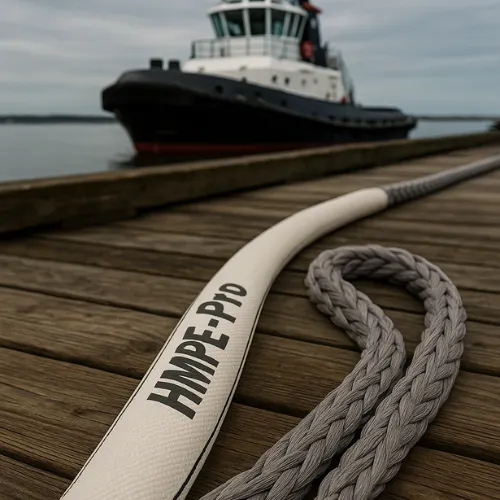
At its core, HMPE rope is built from ultra-high-molecular-weight polyethylene fibers that are oriented for high tensile performance. In practical terms, that produces a rope with a specific and consistent set of characteristics.
- Extremely strong for its weight
- Very low stretch under working loads
- Buoyant and water-resistant
- Chemically stable and unaffected by saltwater
- Immune to rust and corrosion
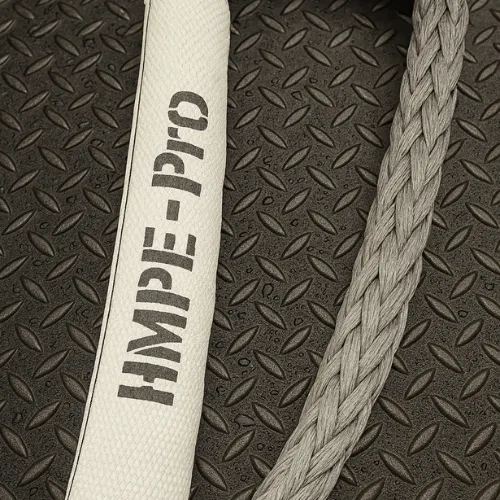
Most heavy-duty HMPE ropes used in industrial service are braided constructions, commonly 12-strand. That construction is not cosmetic. It directly affects how the rope handles in the field, how efficiently it can be spliced, and how it responds to bending and cyclic loading.
A useful way to frame the difference is simple and operational:
- Steel wire rope is a metal machine element.
- HMPE rope is a high-strength fiber structure.
That difference in structure is why HMPE accumulates damage differently than steel and why inspection and retirement cannot follow the same assumptions.
Strength-to-Weight is the First Major Difference
Once material behavior is understood, the first operational difference becomes obvious. Weight is not a secondary specification. It directly affects handling time, crew exposure, and system loading long before rated capacity becomes relevant.
Steel wire rope incurs a significant weight penalty even at moderate diameters. HMPE rope achieves comparable breaking strength with substantially less mass, and that single change reshapes day-to-day operations.
- Faster rigging and derigging
- Reduced physical strain on crews
- Easier staging and transport of long lengths
- Lower contribution to system dead load on cranes, winches, and vessels
This is not a convenience advantage. It is a change in how risk is introduced through handling, fatigue, and human behavior.
When a line is easier to manage, it is handled correctly more often. When it is heavy, stiff, and awkward, shortcuts become more likely. Those shortcuts are where exposure accumulates.
Corrosion and Hidden Capacity Loss
Weight is the most visible difference between HMPE rope and steel wire rope. Corrosion is the more consequential one, because it undermines capacity quietly and inconsistently.
Steel wire rope is constantly exposed to corrosive forces. In saltwater, washdown environments, road chemicals, and high humidity, capacity loss occurs through multiple mechanisms at once.
- External corrosion and surface pitting
- Internal corrosion at the core and between strands
- Lubricant breakdown that accelerates fretting and wear
- Rust products that increase internal abrasion and heat
HMPE rope does not rust. That does not make it immune to damage, but it removes one of the least predictable degradation paths steel wire rope must contend with.
This is why steel often loses capacity quietly, while HMPE forces damage to present itself earlier and more visibly. Anyone who has cut open a wire rope that appeared serviceable on the outside and found advanced internal degradation understands why eliminating that variable changes how confidently a rope can be evaluated in service.
Fatigue, Geometry, and Where Control Matters Most
Once corrosion is removed from the equation, fatigue becomes the dominant life driver. This is where HMPE and steel diverge sharply in how they demand control.
Steel wire rope mitigates fatigue through its metallurgical behavior. Individual wires crack over time due to repeated bending and tension cycling. Damage is gradual, familiar, and well understood.
HMPE rope manages fatigue through fiber behavior. There are no wires to crack. Instead, damage develops through abrasion, compression, internal heating, and localized overload. That damage can progress quickly if geometry is poor. Bend radius, fleet angle, drum size, and contact conditions become critical. Tight bends, uncontrolled edges, and frictional heat concentrate damage in ways that steel may tolerate longer.
HMPE removes some failure mechanisms while concentrating others, which is why geometry and heat control become non-negotiable. This does not make HMPE fragile. It makes it specific. When systems are designed with appropriate bend radii and protected contact points, HMPE can deliver excellent fatigue performance. When those controls are absent, service life can collapse.
Failure Behavior and Safety
One of the most common mistakes in rope selection is assuming that a material change also changes the nature of the risk. It does not. What changes is how risk presents itself and how easily it is misread.
Steel wire rope carries significant mass, and when it fails, that mass and stored energy can produce severe recoil and unpredictable motion. HMPE rope weighs far less, but it remains a low-elongation, high-tension line. Under load, it can still release energy rapidly and violently.
The distinction that matters is not which rope is safer in failure. The distinction is where confidence tends to drift. Steel’s danger is familiar and widely respected. HMPE’s lighter weight and cleaner handling can invite underestimation if failure behavior is not treated with the same discipline. Failure behavior does not make one rope safer than the other. It determines how easily risk is underestimated. Snapback awareness, exclusion zones, and controlled procedures remain mandatory regardless of material choice.
Inspection and Predictability in Service
Inspection culture is where the difference between HMPE and steel becomes operational. Steel wire rope inspection relies on familiar indicators. Broken wire counts. Deformation. Corrosion. Diameter loss. These signals are widely understood and deeply embedded in industry practice.
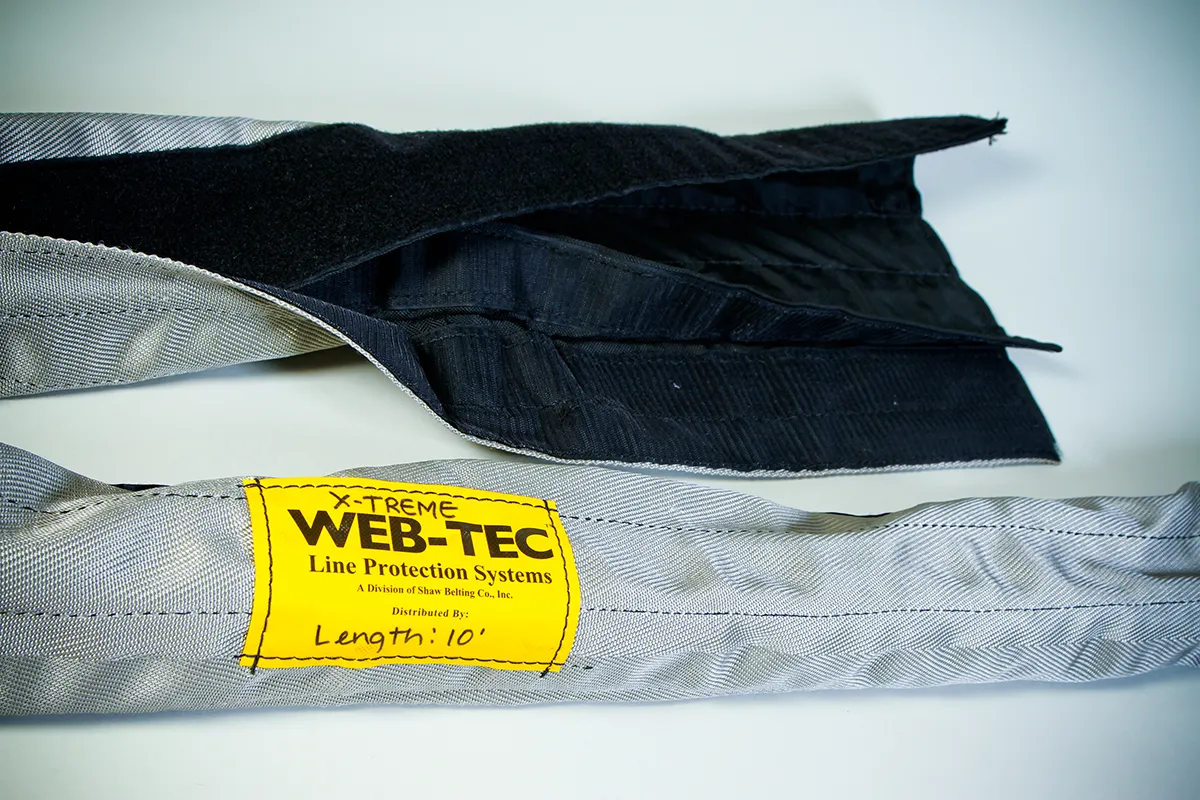
HMPE rope demands a different discipline. Inspectors must look for abrasion patterns, cuts, heat-glazing, stiffness changes, and localized diameter loss. Damage tends to be more visible, but tolerance for that damage is lower. Steel often degrades internally before it looks compromised. HMPE often looks compromised before it fails.
Predictability depends on whether inspection practices match the material. When they do, HMPE can be evaluated with confidence. When they do not, risk increases quickly.
Using Failure Behavior as the Decision Lens
Seen through the lens of failure behavior, the choice between HMPE and steel becomes easier to evaluate in practice. HMPE tends to perform best when corrosion, handling burden, and system weight dominate risk, and when geometry, heat, and inspection discipline can be controlled.
Steel remains the better choice when heat exposure, sharp edges, crushing, and uncontrolled contact are unavoidable, or when inspection programs must rely on traditional wire rope indicators across varied crews and environments. This is not a question of adoption or resistance. It is a question of alignment between material behavior and operational reality.
The Decision Is About Predictability
Rigging decisions fail less often due to insufficient strength and more often because materials behave differently than expected under real conditions. Corrosion that advances internally. Weight that alters handling behavior. Fatigue that accumulates where inspection is least certain.
Steel wire rope remains foundational because its risks are familiar and its failure modes are understood. HMPE earns its place when those familiar risks become liabilities and when the operation can control heat, edges, and inspection discipline. The correct choice is not about preference or innovation. It is about which rope stays predictable as conditions deteriorate.