Selecting the right crane wire rope starts with the crane system, not just the rope. Size, strength, and price all matter, but they do not tell the full story. A rope that matches the old diameter or capacity can still perform poorly if it does not match the crane, the rope’s job, the duty cycle, the load behavior, the operating environment, or the reason the previous rope wore out.
At Bilco Group, we look at crane wire rope selection as an application decision. The goal is not to find the “best” rope in general. The goal is to match the rope to the work it has to do.
That distinction matters because replacement rope selection should not be treated as guesswork. OSHA’s wire rope selection criteria state that replacement wire rope must follow the recommendation of the wire rope manufacturer, the equipment manufacturer, or a qualified person. OSHA also states that wire rope must be compatible with the equipment’s safe function. In practical terms, the rope has to fit the crane system and the way the crane works, not just the quote request. (osha.gov)
Start with The Crane System
The first question should not be, “What is the strongest rope we can get?” The better question is, “What does this crane need this rope to do?”
A crane wire rope recommendation depends on the equipment, the manufacturer’s requirements, the rope’s function, and the conditions the rope is subject to. If we only know the rope size, we do not know enough. Diameter tells us fit. It does not confirm construction, grade, rotation behavior, system compatibility, duty cycle, or why the last rope is being replaced.
For overhead and gantry cranes, OSHA says hoisting ropes should follow the crane manufacturer’s recommendations. OSHA also states that replacement rope should be the same size, grade, and construction as the original rope furnished by the crane manufacturer, unless a wire rope manufacturer recommends otherwise because of actual working condition requirements. That phrase is important: actual working condition requirements. If the previous rope performed normally, the original specification may be the correct starting point. If the previous rope wore out early or showed unusual damage, the application should be reviewed before ordering the next rope. (osha.gov)
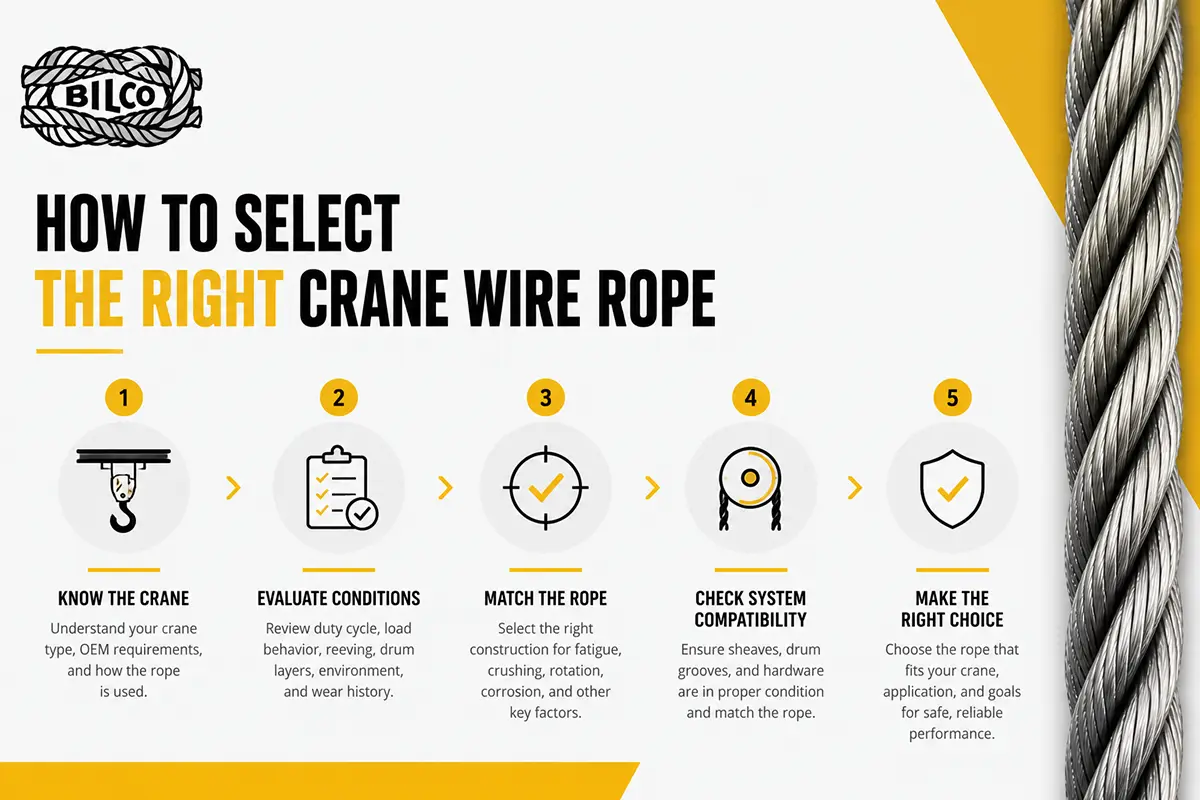
Before recommending crane wire rope, Bilco wants to understand:
- What type of crane or hoist is using the rope
- What the OEM or crane manufacturer specifies
- Whether the rope is used for hoisting, boom hoist service, trolley travel, or another crane function
- Whether the customer is replacing rope due to normal wear, early failure, corrosion, damage, or inspection findings
- How often the crane runs
- Whether the rope works through demanding reeving, drum, sheave, or contact conditions
- Whether the environment includes moisture, salt, heat, chemicals, dirt, or outdoor exposure
Those details help prevent a simple reorder from becoming a repeat problem. The selection process should begin by confirming whether the job is a straightforward replacement or whether the previous rope’s wear pattern, duty cycle, or crane setup points to a different recommendation.
Match the Rope to The Main Wear Conditions
Crane wire rope selection becomes clearer when we identify what the rope must withstand. Strength is required, but strength alone does not explain how the rope will behave in service.
A rope may need to resist bending fatigue, crushing, abrasion, rotation, corrosion, or a combination of those conditions. The main concern changes by crane, application, and work pattern. A crane used for frequent production lifting creates different rope demands than a crane used occasionally. A rope that winds onto a multi-layer drum faces different stress than a rope moving through a simpler path. A marine or outdoor application raises different concerns than a controlled indoor application.
The technical research supports this broader view. A review of wire rope fretting behavior identifies repeated cyclic load as a key factor in wire rope performance. It also notes that lubrication, coating, corrosive media, operating temperature, material, and tensile strength affect fretting behavior. That means service life depends on motion, contact, environment, and repeated working conditions, not capacity alone. (link.springer.com)
Use the table below as a practical selection guide.
| If the Crane Application Involves | Selection Concern to Review | Why It Matters |
| Frequent lifting cycles | Fatigue resistance | Repeated bending and loading can shorten rope life even when rope strength is adequate. |
| Multi-layer drum winding | Crushing resistance and spooling behavior | The rope may be compressed, flattened, or damaged as layers build on the drum. |
| Long lifts or unguided loads | Rotation behavior | Load spin can create control issues and may require a rope selected for rotation resistance. |
| Outdoor, marine, or wet service | Corrosion resistance and lubrication | Moisture, salt, and contamination can accelerate deterioration. |
| Early rope failure | Cause of wear before reorder | The same rope may fail again if the system condition caused the damage. |
| Worn sheaves, rough grooves, or poor spooling | Hardware condition before rope selection | A new rope can be damaged quickly if it runs through poor contact surfaces. |
| Shock loading or abrupt starts and stops | Dynamic loading concerns | The rope sees more than the static load weight. |
This is why “best” is usually the wrong way to think about crane wire rope. The better question is, “Best for what condition?”
A rope selected for fatigue resistance may not be the same rope selected for crushing resistance. A rope selected to control rotation may not be appropriate for every repetitive lifting situation. A rope that works well in one crane system may not be the right rope for another crane with a different rope path, load pattern, and operating environment.
Once the main wear condition is clear, the rope recommendation becomes easier to narrow because the selection is tied to the problem the rope has to survive.
Look at Load Behavior and Duty Cycle
Load weight is only one part of crane wire rope selection. A crane used for occasional controlled lifts does not place the same demand on rope as a crane used for frequent production lifting, repeated starts and stops, shock loading, fast cycling, or long lifts where rotation becomes a concern.
The rope sees motion, not just weight. Repeated bending, twisting, contact, and load cycling can shorten service life even when the rope meets the required strength. A 2024 root cause analysis of steel wire rope failures identified cyclic stresses as the primary cause. The study also found that repeated twisting and contact with groove flanges and sheaves during hoist operation worsened fatigue failure. For crane rope selection, the point is clear: the way the crane operates can matter as much as what it lifts. (link.springer.com)
Rotation risk should also be treated as an application question. A long lift, unguided load, or spin-sensitive operation may require a different conversation than a short, controlled lift. Rotation-resistant rope is not a generic upgrade. It has to fit the crane setup, lift pattern, duty cycle, and manufacturer guidance.
For Bilco customers, the better questions are:
- Is rotation creating a real operating problem?
- Is the lift long, unguided, or sensitive to load spin?
- Is the crane performing repetitive lifts?
- What does the crane or rope manufacturer recommend?
- What happened with the previous rope?
Those answers help narrow the recommendation. They also help prevent a customer from solving one problem while creating another. This information helps separate a rope that meets only the load requirement from one that is better matched to how the crane actually operates.
Avoid Shortcuts That Lead to The Wrong Rope
Most poor crane rope decisions start with incomplete information. Size, strength, price, and the previous rope all matter, but none of them should make the decision alone.
Common shortcuts include:
- Reordering only by size:Diameter does not confirm construction, grade, duty fit, rotation behavior, or system condition.
- Choosing by strength alone:Capacity matters, but the rope still needs to match bending, crushing, abrasion, rotation, and environment.
- Assuming the old rope was correct:If the previous rope wore early or showed unusual damage, the application should be reviewed.
- Ignoring the crane system:Rope life can drop when the rope runs through worn grooves, poor winding conditions, tight bends, repeated contact points, or hardware that damages the rope.
A better replacement process starts with the working conditions. The goal is not to overcomplicate every order. The goal is to ensure the details that affect the recommendation are known before the rope is selected.
When a customer calls Bilco, the most useful information is not only the rope size. It is the full picture around the rope: the crane, the rope’s job, the manufacturer’s requirements, the old rope’s wear pattern, the load behavior, the duty cycle, and the environment.
Talk to Bilco Before Replacing Crane Wire Rope
Bilco Group helps customers select crane wire rope by reviewing the application, not only the rope description. We want to know which crane the rope is on, what the rope does, what the manufacturer requires, how the rope moves through the system, the conditions it operates in, and why the rope is being replaced.
The right crane wire rope is not the strongest rope in general. It is the rope that fits the crane system, the application, and the conditions that create wear. If the previous rope wore out early, the next step should not be a blind reorder. Talk to us today about replacing your wire rope.