
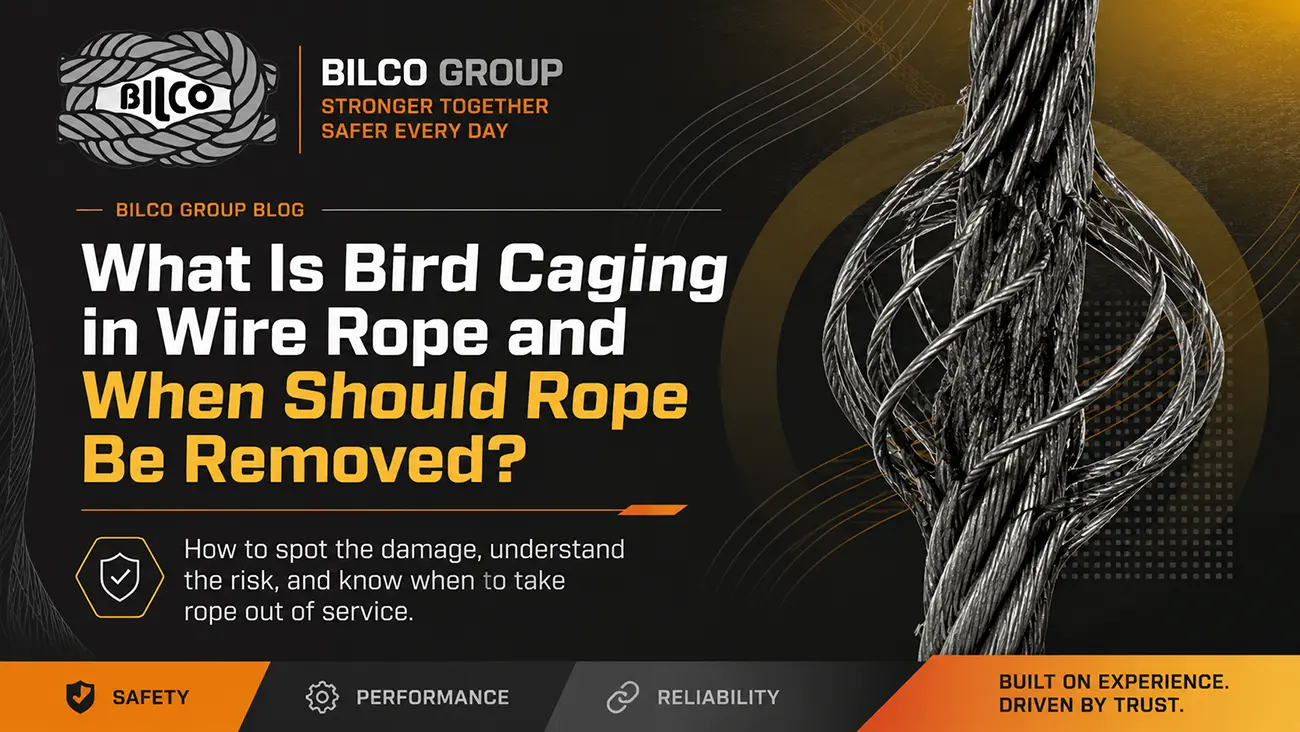
A bird-caged wire rope creates a decision problem before it creates a replacement order. The rope has already changed shape, the outer strands have already moved away from the rope body, and the damaged section no longer deserves normal service assumptions. Customers who know wire rope often call this bird caging by name. Other customers know something looks wrong before they know the technical term, and the concern is the same: the rope body has opened and no longer matches the surrounding strand pattern.
In a load-bearing application, the first question is not how small the cage looks. The first question is whether the rope should stay in operation at all. The safest response is to stop use, isolate the rope, document the damage, and have a qualified person review the rope before reuse or replacement. Bilco commonly sees bird caging tied to shock loading, repeated bending through the equipment, and sheaves that are too tight. If the team replaces the rope without finding the cause, the new wire rope might fail the same way.
Why Small Bird Caging Is Still a Serious Finding
There is no useful field rule that says a small bird cage is safe to keep running in load-bearing work. A short visible deformation might still indicate a serious structural problem, especially when the rope carries load, bends over sheaves, winds on a drum, or works near people. The size of the visible cage does not prove the size of the underlying problem. The rope path, recent load events, construction, and application all matter.
A small bird-caged section might be the first visible sign of shock loading, repeated bending through the equipment, tight sheaves, drum damage, sheave problems, or separating wire rope lay. It might also sit near a critical stress point, such as a crossover area, an end fitting, a sheave travel zone, or a repeated pickup point. That is why appearance alone gives a weak basis for continued use. The safer decision is to stop the rope and have the condition reviewed before reuse.
The same caution applies to replacement. A buyer might be tempted to match the old rope by diameter and move on. That approach misses the question that matters most. If the cage formed because the rope was shock loaded, bent repeatedly through the equipment, run through tight sheaves, or used in the wrong equipment path, the new rope might develop the same damage.
When Bird Caging Means Wire Rope Should Be Removed
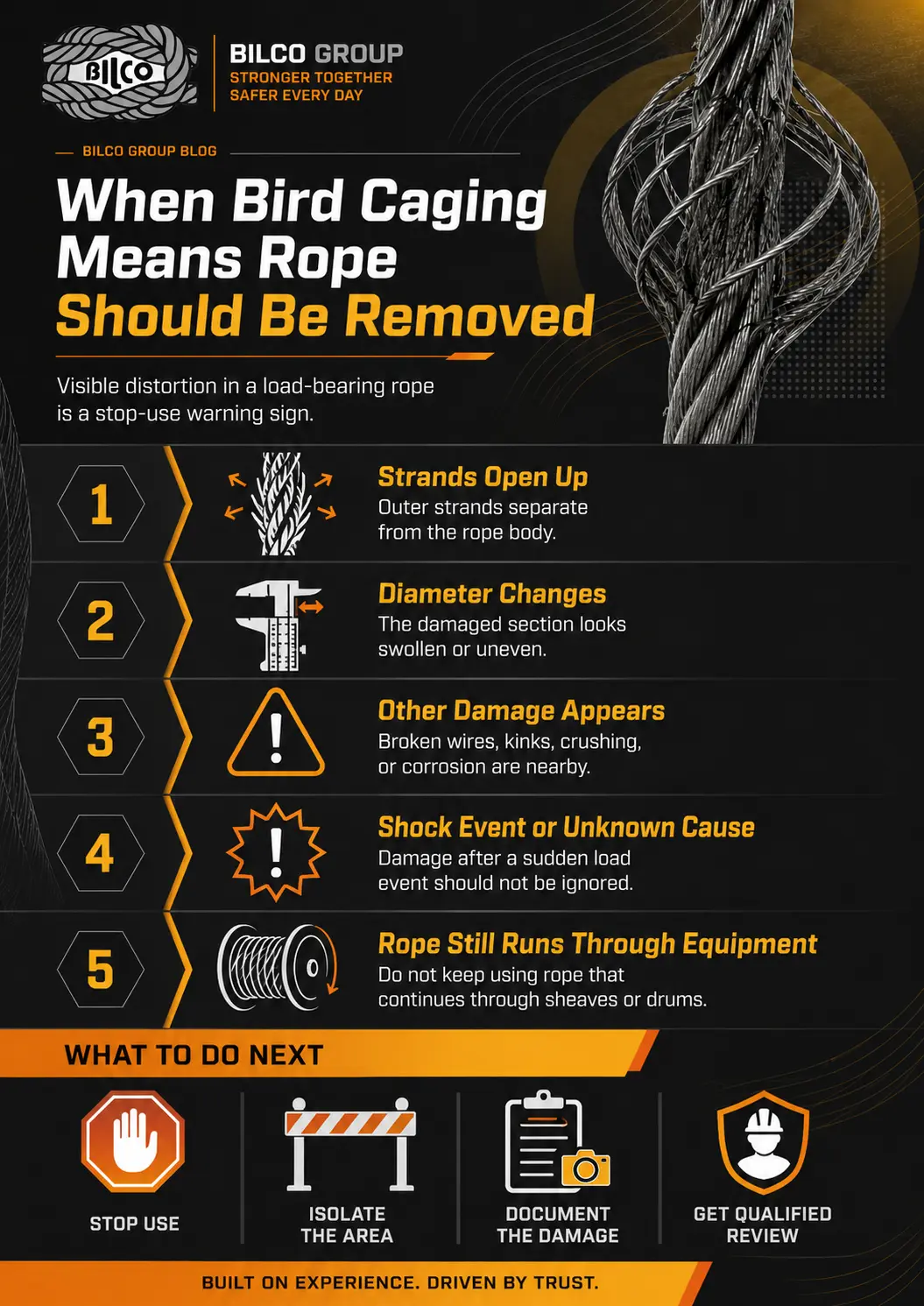
A wire rope with visible bird caging should be removed from service or isolated from use until a qualified person evaluates it. OSHA and ASME guidance treat bird caging as a serious distortion of rope structure in load-bearing applications. For wire rope slings, bird caging is treated as an immediate removal-from-service condition. For cranes and hoists, visible bird caging requires a competent or qualified review because it might create an immediate hazard.
The safest field rule is direct. If true bird caging appears in a load-bearing section, stop using the rope. Do not keep running it to finish a shift, complete a lift, or see whether the damage gets worse. The rope has already changed shape, and the visible deformation indicates it no longer meets routine service assumptions.
The removal decision becomes more urgent when bird caging shows signs of standard rejection, including broken wires, wear, bending damage, reduced diameter, or a separating wire rope lay. The same visible defect carries different risk depending on where it appears and what the rope is doing. Load-bearing work needs the strictest response because the rope is supporting, moving, holding, or controlling force.
| Condition Found | Why It Matters | Field Response |
| Visible bird caging in a load-bearing section | The rope structure has changed, and the damaged section might not carry load as intended. | Stop use and isolate the rope until a qualified person reviews it. |
| Bird caging near a drum, sheave, or crossover area | The cause might sit in repeated bending, winding, groove condition, or sheaves that are too tight. | Inspect the rope path before choosing the replacement rope. |
| Bird caging with broken wires, wear, bending damage, reduced diameter, or separating wire rope lay | The visible cage appears with standard rejection signs, not an isolated surface flaw. | Remove from service and document all related damage. |
| Bird caging after shock loading, snagging, or sudden tension release | A recent load event might have changed the rope structure beyond the visible section. | Stop use, record the event, and review the full system before replacement. |
| Bird caging with unknown cause | The same unknown condition might damage the replacement rope. | Do not replace by diameter alone. Review construction, application, and hardware path. |
What to Do When You Find Bird Caging
When bird caging appears, the first response should control the hazard and preserve useful information. Do not try to straighten the rope, force the strands back into place, or run the rope to see whether it settles. A distorted rope body is not something to bend, hammer, or correct in the field. Treat the rope as damaged until a qualified person decides the next step.
- Stop use:Remove the rope from service if it is used for a load-bearing application. Keep the rope out of service until the damage receives proper review.
- Control the area:Keep people away from the load path, equipment path, and affected rope. A damaged rope should not stay in normal traffic or work zones.
- Tag the rope:Mark the rope or equipment so no one returns it to service by mistake. A visible tag prevents confusion during shift changes, maintenance handoffs, and purchasing conversations.
- Document the damage:Take clear close-up photos of the bird-caged section. Add wider photos that show where the damage sits in the rope path.
- Record rope details:Note the rope diameter, construction, material, core type, lay direction, fittings, visible markings, and application. These details matter more than diameter alone.
- Document recent events:Record shock loading, sudden stops, snags, poor winding, unusual noise, jammed equipment, or changes in rope behavior. Recent operating history often explains why the rope opened.
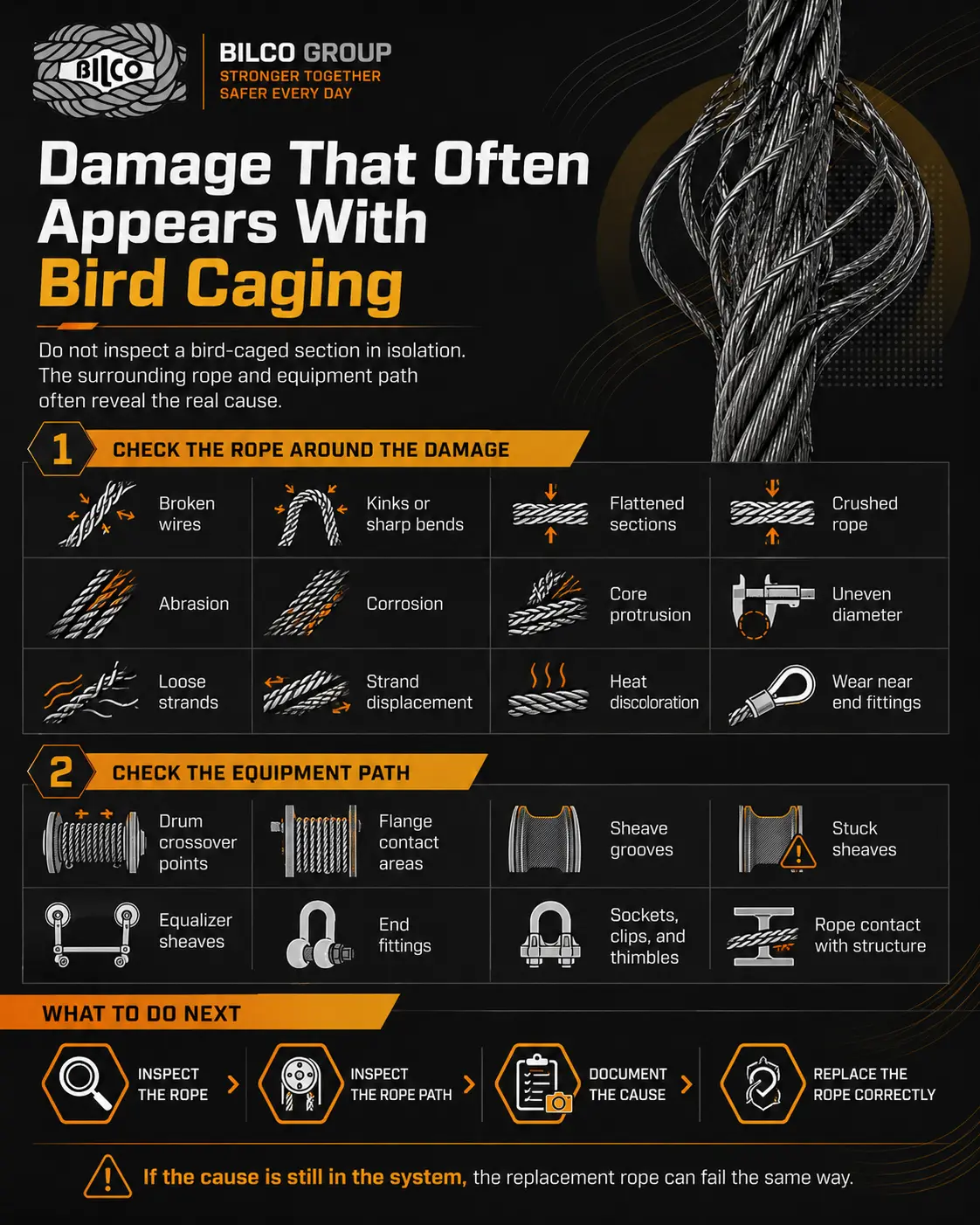
- Inspect the system:Check the sheaves, drum, flange points, crossover zones, end fittings, and any contact points. The damaged rope is only one part of the problem.
- Get qualified review:Contact a qualified wire rope professional, inspector, supplier, or manufacturer before reuse or replacement. The decision should account for the rope, the damage, and the full application.
What Information to Collect Before Asking for Replacement
A replacement conversation should start with the rope and the system, not only the rope diameter. Diameter helps identify the rope, but it does not explain why the rope bird-caged. A qualified review needs enough information to connect the visible defect to the load, equipment path, and application. That is how the team avoids treating the damage as a simple product swap.
The most useful details are practical and field-based:
- Clear photos of the bird-caged section
- Wider photos showing where the damage sits in the rope path
- Photos of drums, sheaves, end fittings, and contact points
- Rope diameter, construction, material, and core type
- Lay direction and visible rope markings
- Type of application, such as lifting, pulling, towing, hoisting, or marine use
- Recent shock loading, snagging, sudden stop, jam, or tension release
- Known issues with repeated bending, sheaves, grooves, drums, or fittings
This information helps separate a damaged rope from the condition that damaged it. A close-up photo of the cage shows what happened to the body of the rope. Photos of the drum, sheaves, fittings, and route through the equipment help explain why it happened. Without that larger view, the replacement choice starts with too little evidence. That is the information Bilco needs to help connect the visible bird caging to the rope, the load, and the equipment path before a replacement decision is made.
The Biggest Mistake after Finding Bird Caging
The biggest mistake we see is trying to straighten the wire rope and reuse it. The rope might still be in one piece, but its structure has changed. That change matters because the rope depends on strand position, core support, and controlled geometry. Once the rope opens, the damaged section should not be trusted without review.
The next mistake is replacing the wire rope without learning why the bird cage formed. If the cause was shock loading, repeated bending through the equipment, tight sheaves, poor winding, damaged sheaves, improper installation, or wrong rope construction, the new rope might develop the same damage. Replacement solves the visible defect only when the root cause has also been addressed. Otherwise, the same system keeps working against the next rope.
A stronger response starts with three questions. These questions keep the team focused on the damaged rope and the system condition that created it. They also help prevent a replacement order from becoming a repeat failure.
- What changed in the rope?
- Where did the rope change?
- What operating condition forced the rope to open?
The Safe Decision after Bird Caging
Bird caging in wire rope is visible proof that the rope has lost its intended structure. The safest response in any load-bearing application is to stop use until a qualified person reviews the rope, the surrounding damage, and the equipment path. The visible cage matters, but the cause matters too, because shock loading, repeated bending through the equipment, tight sheaves, or the wrong rope construction might damage the replacement the same way. A proper response checks the rope body, broken wires, wear, bending damage, reduced diameter, separating wire rope lay, drum path, sheaves, fittings, and recent operating history before the system returns to service. Diameter alone does not give enough information to choose the next wire rope because construction, core, lay direction, fittings, and application all affect performance. When bird caging appears, the real decision is not how long the rope might last; it is how quickly the team stops the risk, finds the cause, and puts the right rope back into the right system.